Monday, April 13, 2015

Text Mapping

If you follow me on Instagram {if you don't, you totally should!} then you have probably seen this picture I posted last week.

I had several people ask to learn more about what I did with my students. So, I decided to share it here with you! At the beginning of the year, I wanted to teach a little science in reading to help the science teacher out. We decided that I would cover a unit about how people and technology can aid in erosion and weathering. I saw a pin on Pinterest over a year ago. Here it is below.
I thought it was really cool, but I was afraid of it! It looked like a lot of planning, explaining, and patience. A couple of weeks ago, I knew I needed to teach this science unit ASAP. The science textbook had a lot of useful information, but I didn't want to just have the students read it. How boring is that? So, I finally decided to read the blog post. It had a ton of useful information, however the best information can be found on the Text Mapping Project page. There is a ton of information here and everything you need can be found. Once I read up on all the information I would need, I started to create my color codes. I then created a Powerpoint presentation and talked to the students about how to do it. 


Before you begin, you will need to copy the pages from the science textbook that you will be using. Since each student had their own copy, copyright should be okay. It would NOT be okay if you copied pages from a text that you do not have enough for each student. Students will need to tape together the pages to create a scroll. You can read all about the setup, prep, and process at the Text Mapping Project page.

To make it easier, I divided my class into 6 groups. Each group had their own caddy with all of the needed supplies in it. They were able to take it where they were working (mine worked on the floor) without having to get up and go get what they needed. I'm hoping this answered some of your questions! Let me know if you have others after reading my post :)

Labels:

Monday, April 14, 2014

Falling in Love with Close Reading

Don't you love the interaction between students and text when they close read?  I started {somewhat} using close reading this year, but I wanted to read a little more into it to get a better idea of what I was doing and how to guide my students to reach the deep understanding I want them to.  This past summer, I read Close Reading of Informational Texts.
This book was a great introduction to what close reading is and what it looks like in informational texts.  It left me wanting a little more.  Especially for my fiction readers.

That's when I found Falling in Love with Close Reading.  Have you heard about this book?  Maybe you have even read it!  I'm picky about my professional reads, because I can't read just anything.  I get easily distracted and bored... quick like!  If I'm going to finish a professional read, it has to be something highly engaging and something I can use in my classroom and small group instruction.


To be honest, the first chapter was just an introduction.. a little hard to get through.  So, I'm going to talk mostly about chapter 2.

This was a great chapter about helping students find text evidence in fiction and informational text.  I'm not going to give too many details, but I'm going to share some "Aha" moments I had as I read.  The focus of this chapter was based around a chart/anchor chart to help guide students  to close read their texts.  You can download the picture below to download a .pdf version of both fiction & informational.

  • As students read, have them write down things from #1 on your chart.
    • What do the characters say/think/do?
    • What are some relationships?
    • What do you notice about the setting?
    • What do you notice about the time period?
  • Then, have students sort through their notes and highlight related facts by color or by placing them in categories.
  • Students should ask themselves questions from #2 on your chart:
    • Which details fit together?
    • How do they fit together?
  • Then, students should look at any patterns and develop new ideas based on those patterns.


  • First, students read and record any facts, phrases, descriptions, photos, or graphics they do not understand.
  • Then, have students sort through their notes and highlight related facts by color or by placing them in categories.
  • Students should ask themselves questions from #2 on your chart:
    • Which details fit together?
    • How do they fit together?
  • Then, students should find patterns with confusing information.  Then, understanding can begin to come.

  1. The reason why the character __________ is because __________.
  2. It seems like this character tends to __________.
  3. My thinking about this character has changed because __________.
  4. These characters are really different because ___________.
  5. One issue I am noticing in this book is ___________.
  6. I think the author is trying to teach me __________.
  7. I think this because the author wrote __________.


  • Students can use stickies to record facts
  • Students can use highlighters/crayons to color-code common facts
  • Patterns help us see what's important
  • Start with simple examples to share as a introduction so you will have room to revise
  • Close reading may not be necessary every time
Overall, I was pretty excited about this chapter!  Don't miss chapter 3!


post signature


Labels: , ,

Thursday, April 10, 2014

Text Features Anchor Chart & Activity

You may have read my post here where I discussed some text structure activities I completed with my students.  After we spent a few weeks on text structure, we reviewed some text features this week.  Although text features are not a 5th grade standard, I thought it would be a good idea to review these.  We looked at them briefly this week and will be moving on to review some fiction elements next week.  We have state testing in less than two weeks... YIKES!

Here are some activities we did together.

First, we started off with an anchor chart that contained several examples.  Each student had a Text Feature Mini Book that went right along with the anchor chart.  It is very similar to the Text Structure Mini Book that I used in my post linked above.  Both of these are from Jen Jones' Reading Comprehension Sheets for Informational Reading.  I love this resource!  All of the pictures on my anchor chart are also from this resource.

This is what it looked like before we added our information.  I forgot to take a picture of all the content we added.


I also created a short and to the point Powerpoint that goes along with this anchor chart.  I have it on my computer at work, so I will have to link it up later.

After we talked about each text feature, the students were placed in groups of 2-3 students.  They were given a Scholastic News magazine and small post-it notes.  The students worked with their partners to examine and identify the text features on each magazine page.


They worked so hard and throughly enjoyed this activity.  I was quite impressed with the conversations that were happening between the group members.


I gave students a recording sheet to reflect on each feature and analyze the information presented in each text feature.


This recording sheet is nothing fancy, but you can click the picture above to download the file.  Tomorrow, I will have some of the students present their findings to the class.  We will spend a few minutes at the end looking at our EQ once again and making sure the students can answer the question.

Lastly, we reviewed a little of comparing two text structures.  Here's the organizer my students helped me fill out today while we were going over our homework.  The hardest thing for my students is comparing the text structures and not the content of the passages.  That's been our most challenging task thus far.  Hence the reason we reviewed this today!


Like I said before, I think nonfiction is probably my favorite to teach.  I love helping the students develop critical thinking skills when reading and analyzing nonfiction texts.

What are your favorite reading skills to teach?

post signature

Labels: , ,

Monday, March 31, 2014

Text Structures & What I've Been Up To!

WOW!  I am ashamed to say that I haven't posted here since November.  This school year has been one of the CRAZIEST years since I started teaching.  First of all, I had NO IDEA how difficult it would be changing grade levels.  I've taught 5th grade before, but the common core has totally changed things up!  And... I hate to admit it... but I kind of like it!  I love the rigor of the curriculum and the challenge it brings to my 5th grade students.  Then, we had to miss six days.  One day was because it was soooo cold!  The district was concerned about all the students that would be out waiting for buses without coats.  The other five were due to snow.  So, we've been having to make those up on top of everything else.  Fortunately, our spring break is this week.  Unfortunately, we have to make up two of those days before we get our three days off.  BUMMER!

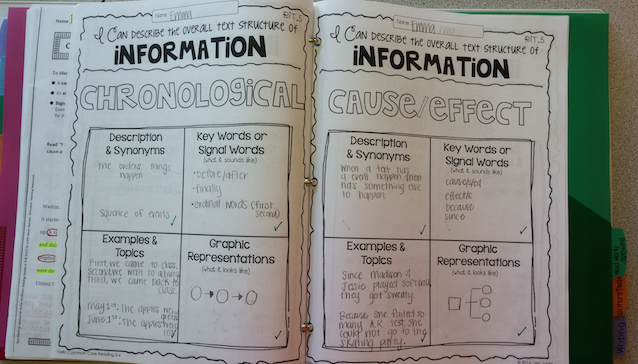
Anyways, I have felt {REALLY} lost and all over the place this year.  I've changed things, added things, and taken some things away.  I'll have to post more about all that later.  What I want to share with you today is the nonfiction text structure unit I finished up with my kiddos on Friday.  This has been my favorite unit by far.  I just love the resources I have found to go with it.  For this unit, I used these resources:

Lovin Lit's Interactive Reading Informational Text Notebooks


Teaching with A Mountain View's Text Structure Task Cards

Teaching with A Mountain View's Text Structure Anchor Chart

and this wonderful resource that I LOVE!

{I highly recommend this book!}

Just a little bit about this resource... it has a variety of text structures as well as reading skills.  Each skill has three differentiated passages to help you differentiate for your students.  I usually do passages #1 & #3 for my advanced students and passages #1 & #2 for my struggling students.  I teach two leveled groups, but I will have both varieties in each class.

and...


 ------------------------------------------------------------
To get the unit started, my students chose a topic and then thought of sentences that would be a good example for each text structure based on the topic.


We kind of went around so every group had a chance to add their sentence to the chart.  We then reviewed several of the examples and talked about whether it was a good fit or needed a little bit more information.  After we discussed a few good examples and some that needed work, the students took a sticky and wrote a
for each one.  A 'GLOW' is something the writer did well.  A 'GROW' can be kind of tricky.  We use the term improve.  What is a way the writer could improve their work?  This needs to be modeled for students so they aren't so brutally honest :)

 ------------------------------------------------------------
We then started our anchor chart.  As we filled in our anchor chart together, the students filled their anchor foldable that is located in their binder.  The anchor chart idea came from Mary from Teaching with a Mountain View and the anchor chart foldable came from Lovin Lit's file (above).  Here's what our finished anchor chart looked like.


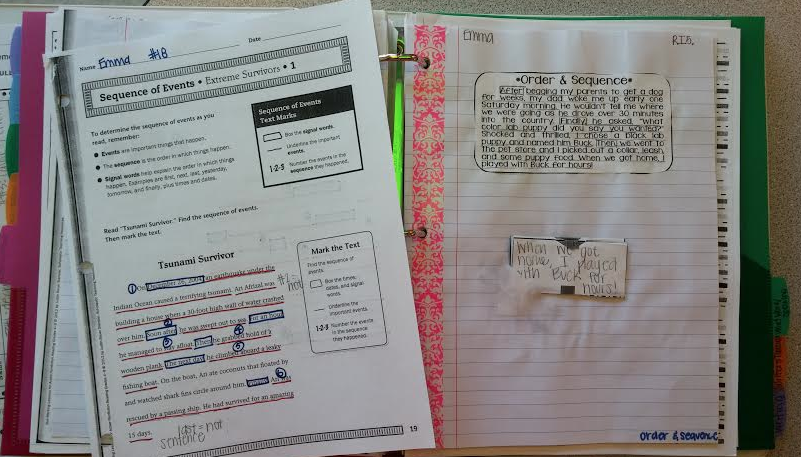
Along with our anchor chart and foldables from Lovin' Lit, we completed the skills text marking activity from the resource book mentioned previously.  Here are a few of the examples.


 ------------------------------------------------------------
Once we reviewed all the text structures, the students were able to apply what they had learned by completing Teaching with a Mountain View's text structure task cards.  These were so awesome!


 ------------------------------------------------------------
The students then used the resource from Jen Jones as an informal assessment.  In order for students to complete their mini-book, they had to complete the graphic organizer first without any resources.  Once we worked on that for a while, I allowed them to work with a partner.  Once time had passed, I then placed the anchor chart back up :)  Not to mention that I wanted them to finish it already!  
Here's a peek at their mini-books.


Our 5th grade standard is to actually take the text structure beyond being able to identify to actually comparing/contrasting two or more text structures.  My students really struggled with this as they wanted to compare/contrast the CONTENT of the paragraphs.


I loved the triple Venn.  We actually used this in math last year, so some of the students were able to activate that schema to help them understand the layout.

To finish our unit, my students completed a final project.  I will share that next week as I still have a few who are finishing it over spring break.

I love teaching informational text.  It's just fun to see the students grow with how they read informational text.

What are some of your go-to resources to teach text structures?

post signature


Labels: , , ,