Sunday, April 12, 2015

Literal Vs. Inferential Questioning

So, I'm not gonna lie! I pretty much used the same exact plans that Mary from Teaching with a Mountain View has on her blog for Literal & Inferential Questioning. You can check out her activities here. We did it all. Here's the breakdown.

Day 1: Anchor Chart & Foldable
Day 2: Task Cards
Day 3: Book Questions Rotation
Day 4: Create Our Questions
Day 5: Library Day

What I really want to talk about today is what went down on Day 4. Does some of your best teaching come at the spur of the moment? I had planned for students to use the books Mary used for her book questions along with some I already had. Students were going to create 2 literal and 2 inferential questions. It was really up to them if they wanted to do just one page or several.

As I was explaining the assignment, it hit me... this would be a GREAT activity to include DOK questions. So, (like I always do.. thank God my room is near the copier) I quickly found a DOK questions stem handout. We then went over what each level meant and what the questions look like. I encouraged them to include at least 1 DOK level 3 questions and the remainder needed to be either DOK 2 or 3. They were so excited to create questions like a teacher! We didn't really go near the DOK 4 questions because they are more for product-type results.

You can download the handout here. I have included what it looks like below.

As we were discussing DOK levels, I spoke to the students that these levels are similar to digging. I have a shovel hanging on my wall that I reference to when I want the students to think deeper. I always tell them to dig deeper :) One of my sweet students decorated a shovel and gave it to me as my end of the year gift last year. You may have seen it on my Instagram before.
I then drew a {horribly illustrated} sketch of a hole being dug into the earth. The first sketch was just scratching the surface of the dirt. I told the students this was like DOK level 1. It just scratches the surface of information and doesn't require a lot of thinking. These types of questions are okay, but we really want to stay away from them. Especially in 5th grade! I then drew a hole that was a little deeper. This represented DOK 2 questions. I'm guessing you kind of get the picture. The students had a lot of fun with this! I think the connection to the DOK levels to using a shovel to dig a hole really helped them.

The students then gathered sticky notes and got to work. They placed the sticky with their question on it on the page the question was from. Once they were finished, they traded books with another partner pair and answered each other's questions. Once everyone was finished, the students shared their questions and placed them on an anchor chart based on whether or not the question was inferential or literal.


Labels: ,

Saturday, April 5, 2014

April Print & Go: 5th Grade Literacy

Hey, ya'll!  I'm back again {can you believe it??} to share with you my recent creation.  It's been a while since I've been motivated to make anything.  I was sooo comfortable with 4th grade math that 5th grade ELA seems so new to me!  I love making things I can use in my classroom with my own students.  I know I teach 5th graders, and many may argue that they don't care about cute things... well, THEY DO!  So, I created a packet of 10 April/Spring printables you can use in your 5th grade classroom to review various CC skills.

Here are the standards for the packet:

5L1a: function of conjunctions
5W2: informational writing
5RI5: text structure
5L2e: spelling grade-appropriate words
RL6: author’s point of view
5RI2: determine two or more main ideas
5L3a: combining sentences
5W1: opinion writing
5W3: narrative writing
5L5b: recognizing idioms
5RI8: supporting a point in a text

Here's a preview!


You can download it HERE.

I also created a freebie to give you an idea of what the packet looks like.  You can download the file by clicking the image below.

Now I'm off to bed!  Spring break has been good to me, but it's ending too soon!

Good Night, Ya'll!
post signature

Labels: , ,

Monday, March 31, 2014

Text Structures & What I've Been Up To!

WOW!  I am ashamed to say that I haven't posted here since November.  This school year has been one of the CRAZIEST years since I started teaching.  First of all, I had NO IDEA how difficult it would be changing grade levels.  I've taught 5th grade before, but the common core has totally changed things up!  And... I hate to admit it... but I kind of like it!  I love the rigor of the curriculum and the challenge it brings to my 5th grade students.  Then, we had to miss six days.  One day was because it was soooo cold!  The district was concerned about all the students that would be out waiting for buses without coats.  The other five were due to snow.  So, we've been having to make those up on top of everything else.  Fortunately, our spring break is this week.  Unfortunately, we have to make up two of those days before we get our three days off.  BUMMER!

Anyways, I have felt {REALLY} lost and all over the place this year.  I've changed things, added things, and taken some things away.  I'll have to post more about all that later.  What I want to share with you today is the nonfiction text structure unit I finished up with my kiddos on Friday.  This has been my favorite unit by far.  I just love the resources I have found to go with it.  For this unit, I used these resources:

Lovin Lit's Interactive Reading Informational Text Notebooks


Teaching with A Mountain View's Text Structure Task Cards

Teaching with A Mountain View's Text Structure Anchor Chart

and this wonderful resource that I LOVE!

{I highly recommend this book!}

Just a little bit about this resource... it has a variety of text structures as well as reading skills.  Each skill has three differentiated passages to help you differentiate for your students.  I usually do passages #1 & #3 for my advanced students and passages #1 & #2 for my struggling students.  I teach two leveled groups, but I will have both varieties in each class.

and...


 ------------------------------------------------------------
To get the unit started, my students chose a topic and then thought of sentences that would be a good example for each text structure based on the topic.


We kind of went around so every group had a chance to add their sentence to the chart.  We then reviewed several of the examples and talked about whether it was a good fit or needed a little bit more information.  After we discussed a few good examples and some that needed work, the students took a sticky and wrote a
for each one.  A 'GLOW' is something the writer did well.  A 'GROW' can be kind of tricky.  We use the term improve.  What is a way the writer could improve their work?  This needs to be modeled for students so they aren't so brutally honest :)

 ------------------------------------------------------------
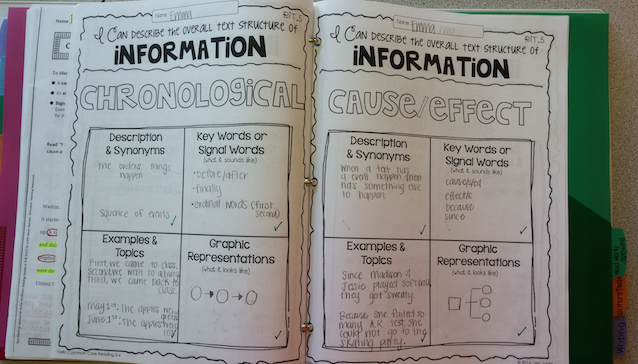
We then started our anchor chart.  As we filled in our anchor chart together, the students filled their anchor foldable that is located in their binder.  The anchor chart idea came from Mary from Teaching with a Mountain View and the anchor chart foldable came from Lovin Lit's file (above).  Here's what our finished anchor chart looked like.


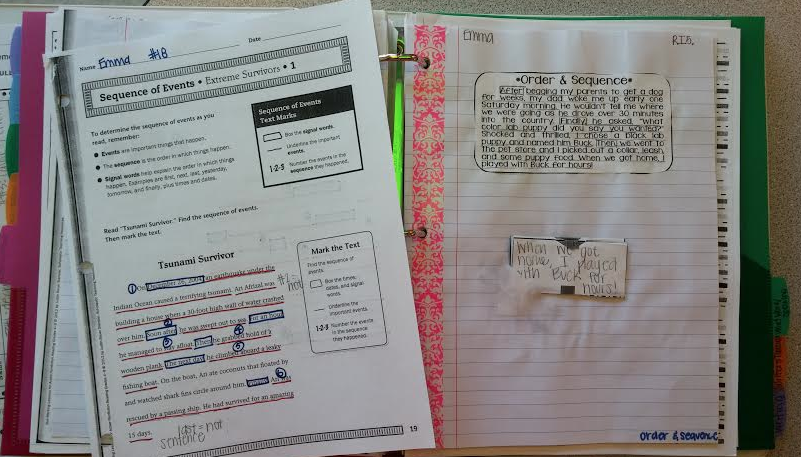
Along with our anchor chart and foldables from Lovin' Lit, we completed the skills text marking activity from the resource book mentioned previously.  Here are a few of the examples.


 ------------------------------------------------------------
Once we reviewed all the text structures, the students were able to apply what they had learned by completing Teaching with a Mountain View's text structure task cards.  These were so awesome!


 ------------------------------------------------------------
The students then used the resource from Jen Jones as an informal assessment.  In order for students to complete their mini-book, they had to complete the graphic organizer first without any resources.  Once we worked on that for a while, I allowed them to work with a partner.  Once time had passed, I then placed the anchor chart back up :)  Not to mention that I wanted them to finish it already!  
Here's a peek at their mini-books.


Our 5th grade standard is to actually take the text structure beyond being able to identify to actually comparing/contrasting two or more text structures.  My students really struggled with this as they wanted to compare/contrast the CONTENT of the paragraphs.


I loved the triple Venn.  We actually used this in math last year, so some of the students were able to activate that schema to help them understand the layout.

To finish our unit, my students completed a final project.  I will share that next week as I still have a few who are finishing it over spring break.

I love teaching informational text.  It's just fun to see the students grow with how they read informational text.

What are some of your go-to resources to teach text structures?

post signature


Labels: , , ,

Sunday, October 6, 2013

Novel Activities, Daily 5 Update, & Anchor Chart Thursdays!

Well... my goodness!  It has been far too long since I've had the opportunity to blog.  It seems like a lifetime ago!  I've been so busy in the classroom, and things are just now starting to die down... just in time for parent conferences :)  Has anyone else's year been like this?  I have so much to share and so little time.  I feel like we are finally getting into our routine... somewhat!

We have been doing Daily 5 since our very first week of school.  It's been going great.  I've been having some great individual conferences with my students.  I feel like the one-on-one time is what's going to help my students get to where they need to be.  Unfortunately, I don't get to meet with everyone every day, and sometimes not even every week.  I'm trying to get into small groups, but I'm having a difficult time finding time for them.  So, I was wondering... how many of you just do individual conferences, how many of you do small group, and how many of you are lucky enough to have time for both??  I have thought about having a specific day of the week set aside for small group and conferences.  I would love hear what you all find time to do in the comments.
--------------------------------------------------------------------
As many of you may know already, I spent the last four years teaching 4th grade math.  I have taught 5th grade reading/ELA before, so I was super excited to find out that I would be teaching it again this year.

We just finished reading Hatchet as a read aloud which is an all-time favorite of 5th grade students.  I am always reading something to my students!  Here are a few activities we did after we finished the book!
A major theme of the book is how Brian changed.  He changed from the old Brian to the new Brian.  One of the 5th grade CC standards is to compare two or more characters.  We compared the old Brian and the new Brian.  I was impressed with all the ideas the students came up with!

We then talked about all the characters and settings.  They came up with some really great ideas that showed me they could 'think outside the box.'  I was so proud of them :)  I love how they included the personified fire... probably my all-time favorite!

We then brainstormed some themes of Hatchet.

Another one of our CC standards is to discuss how characters in a story respond to challenges.  So, we completed this anchor chart together.


The students were able to choose a scene and illustrate it.


The students then completed their final projects.  You can find more pictures of these here on my class website.

These activities can be done with just about any novel.  Hopefully you can use some of them in your own classroom.

--------------------------------------------------------------------

Lastly, last year I started Anchor Chart Thursdays.  I obviously {LOVE} using anchor charts in my classroom, but when I started this weekly post last year, I didn't have a whole lot available in my room since it was towards the end of the school year.  When we get ready for testing in April, we have to take everything down!  I want to start it back up again because ...

#1- I want a way to keep all my anchor charts digital so I can go back to them for years to come.
#2- Anchor charts are such a great way to teach and record students' thinking.
#3- I just want to share them with you!

So... starting this Thursday {even though I just shared... like 4 with you}, the Anchor Chart Thursday post will be back.  It will basically be a short post with an anchor chart I have used this year in my classroom with a short description of how I use it. That easy!

See you then,
post signature


Labels: , , ,

Monday, April 8, 2013

Save this one for next year!

Hello again, friends!  Today was our first day back since spring break.  It went really well considering no one was wanting to be there ;-)  The Zombies students were half asleep, but seemed to wake up (and did they) after lunch.

Anyways, I have been meaning to share this with you.  These activities/centers are something I did with my kiddos before our spring break.  You can put this in a file to use for next year.  I wanted something fun the kids could work on the Friday before spring break... which also happened to be the Good Friday.  I've seen how some of the primary teachers incorporate plastic eggs into math/literacy centers, and I wanted to do this for my 4th graders.  These two center are essentially matching games, but they do require some thinking and working :)  Which you know I love.  I have a difficult time giving students
Read more »

Labels:

Tuesday, August 28, 2012

Anticipation Guides

Have you ever used anticipation guides in your classroom?  While I was reading Guided Math by Laney Sammons this summer, she discussed a variety of activating/teaching strategies to use with your students.  This was an area that I really wanted to work on this school year.  Looking back over the past few weeks, I believe I have really stepped up my game with activating/teaching/summarizing strategies.  This is partly due to the format I am using for my lesson plans this year.  Each day, I have an area designated for activating/summarizing strategies.

Today, I used an anticipation guide as my activating and summarizing strategy.  If you teach CC, this is something you can use with the 4th grade standard of comparing multi-digit whole numbers.  This is what the guide looked like.

There is an area on the left that we answered with T/F {true/false}.  Basically, I took the majority vote, having the students give thumbs up for true or thumbs down for false.  Then, we came back to this at the end of the lesson.  I actually answered the last two {which I love.. makes you go hmmmm...} during small group today.

This is what the guided looked like at the end of the lesson.  We went back and evaluated our choices from the beginning of the class based on our discussions during small group.  This is also a great way to determine if students got it or didn't during the lesson.
Anticipation guides are also a great way to introduce/use vocabulary.  For example, here I used the word least in the third statement because this is another word to use when discussing smallest numbers.

I also wanted to share these cute dry erase pockets that I just couldn't wait to get my hands on.
Here we were comparing small four-digit numbers using base-ten blocks {our version}.  The top row is for our first number and the second row is for our second number that we are comparing.  Here's how the numbers looked once we illustrated them with base-ten.
We talked about why our thousands cubes were illustrated with a square and a 10.  I was surprised that students realized that thousands and hundreds had the same object, but the thousands had a 10 because it takes 10 hundreds to create a thousand. These two numbers we were comparing also opened a great opportunity to discuss the importance of looking at the greatest place first.  We discussed how the bottom number seemed to be larger than the top because it had 'a lot going on.'  Students were able to explain that the top number was in fact the larger of the two because it has more thousands than the bottom.  I was impressed!

The bottom two numbers here were a great example of why statement #3 is not always true.  Statement #3 of the guided stated that the least/smallest number will be the number with the least amount of digits.  Although this is possible, it is also possible to have the same amount of digits and have one be smaller.  It isn't always the number with the least amount of digits.

Our lesson today was really great, and I loved using the anticipation guided to activate my students, get them thinking and talking, guide my small group, and summarize/reflect on our lesson.  I don't know of many things that can do all that!

Have you ever had success with an anticipation guide?
post signature

Labels: , , ,